

Russian, British and Brazilian Escorts in London: Culture, Character and First Impressions
“We must have a coffee sometime” is often a polite goodbye in London, and not everyone who hears it knows that.
Three cultures
Shoes come off at the front door in a Russian home, and a pair of guest slippers appears. New Year outranks Christmas, which arrives separately on 7 January for Orthodox families. The best conversations happen in the kitchen, a custom from Soviet flats where it was the one room for honest talk. There is an old saying that laughing for no reason is a sign of foolishness, so smiles are mostly kept for people you know. Russia covers eleven time zones and well over a hundred ethnic groups, so whether a woman on our Russian escorts page grew up in Moscow or Novosibirsk, her childhood will have looked different from the next one.
Brazilian escorts come from the largest Portuguese-speaking country in the world, where regional differences often outweigh national ones. A first meeting brings one kiss on the cheek in one city and two or three in another. Accents shift between São Paulo, Bahia and Rio Grande do Sul, and so does the food: rice and beans are an everyday lunch almost everywhere, feijoada is a Saturday dish, and in the south people pass round a gourd of chimarrão, a hot herbal mate. The population is just as mixed. The south has strong Italian and German roots, Bahia has deep African heritage, and São Paulo has one of the largest Japanese communities outside Japan.
Home life runs on its own calendar. Sunday lunch is the long meal of the week, and a guest is usually offered a small, strong cafezinho within minutes of arriving. June brings the festas juninas, harvest-style parties with bonfires, corn dishes and square dancing, most loved in the northeast. On New Year’s Eve many people dress in white. Language adds its own warmth: first names come almost at once, nicknames and diminutives are everywhere, and the same word, saudade, covers a longing for people and places far away and has no neat English equivalent.
British manners are built on small talk. The weather is the standard opening, and it is less a topic than a way of saying hello. “You alright?” is a greeting, and the expected reply is “Yeah, you?”, not an account of your week. Disagreement is wrapped up: “That’s an interesting idea” often means the speaker is unconvinced, “quite good” means ordinary, and “with respect” introduces a criticism. “I’ll bear it in mind” usually means no, while “you might want to consider” is closer to an instruction. Apologising is nearly automatic, and people say sorry when someone else steps on their foot.
Personal space follows similar rules. Acquaintances usually greet each other with a nod or a handshake, and hugs are for people who know each other well. On a crowded Tube carriage, eye contact is avoided and nobody speaks. The same people may chat easily in a pub, where a round system governs the evening and leaving before your turn is the one thing that gets noticed.
The UK is also four countries, and the differences are real. England, Scotland, Wales and Northern Ireland each have their own accents and dialects, and Wales has its own language. Terms of address vary too: “love” is common in much of England, “pet” in Newcastle and “hen” in parts of Scotland. The British escorts in London can arrive with any of these, and one woman’s “cheers” may mean thank you while another’s means goodbye.
Three people at one party
The Russian guest introduces two strangers because she thinks they would get on, then argues with the host about a film. An Englishman tells her, “We must have a coffee sometime,” and she opens her calendar. He goes pink. Later she learns he was saying goodbye, and mostly she is sorry about the coffee.
The Brazilian guest has been standing by the bookshelves for half an hour. New people make her shy, and she answers in short sentences until she has worked out who is easy to talk to. Her greeting is automatic all the same: a kiss on the cheek, learned in childhood. The man she has just met offers a hand. They stop halfway, and the kiss ends as a nod.
The British guest tells a friend that the new haircut does not suit her, and cries at the end of the film without apology. When it starts to pour, she says it is perfect picnic weather. A visitor asks where she would like to set up, and she takes a moment to realise he is serious.
Why a first impression misleads
A neutral face is easy to read as coldness by anyone expecting a smile. Where smiles are kept for people you know, it usually means only that a stranger has not been placed yet.
Warm openings get misread the other way. In many places a kiss on the cheek or first names within a minute are simply how a conversation begins, and they say little about how close anyone wants to get. Agreement is similar. “Lovely, we must do that” in an English accent and vamos marcar (“let’s arrange something”) in Brazilian Portuguese can both lead nowhere, while among Russian friends a blunt answer can be a sign of trust.
Compliments follow local rules too. In British conversation they are often waved off with “this old thing”, whereas in Brazilian conversation it is usual to say thank you and offer one back. Pauses differ as well: a silence between friends can be easy in Russian company, and in an English conversation it often feels like a gap someone ought to fill.
London mixes it all
London is one of the most linguistically mixed cities in the world, and daily contact changes habits. A newcomer from Moscow may be surprised by how often she hears “sorry” and by how many different things “interesting” can mean. A Brazilian may notice that queues form without anyone organising them.
Where a person comes from and who she feels she is can differ, and in London they often do. A woman born here to Russian parents might make her grandmother’s syrniki on Sundays and have a very English sense of humour the rest of the week.
Back to the coffee
Where a woman grew up explains how she greets you at the door and what she expects a sentence to promise. Her character decides what she does with all of that, and London keeps adding to it. After a few years here, a Russian may say “sorry” without noticing and a Brazilian may stand in an orderly queue, and neither stops being who she was. If someone says “we must have a coffee sometime”, it is perfectly reasonable to ask which day.
-
 Filming With a Mask: The Look Is Half the StoryOct 07, 2026With her face covered, the eyes, outfit and mask do most of the visual work. Lace or satin, black or red, and what works best with each.Read more...
-
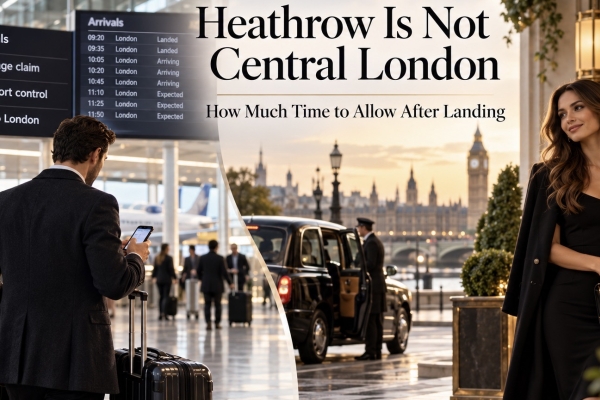 Heathrow Is Not Central London: How Much Time to Allow After LandingOct 01, 2026Landing at Heathrow with a booking in London the same day? Passport control, baggage and the trip into town all take time. This article explains how long to allow and which train suits which part of the city.Read more...
-
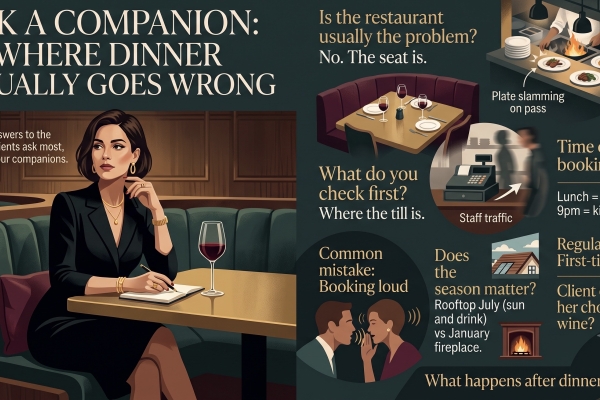 Ask a Companion: Where Dinner Actually Goes WrongAug 18, 2026A companion answers the questions clients ask most before booking a table, including what to do when they've already picked the wrong one.Read more...
-
 The Luxury Paradox: Why Clients Who Ask for Less Usually Have Better ExperiencesAug 11, 2026Notes on why we shortened our intake form, and what that change taught us about the value of a short conversation before a booking.Read more...


