

The Chemistry Between Two: How an Evening Either Holds Together or Doesn't
By one of our London companions — on the evenings that stay with you, and why
I have done enough duo bookings in London to know whether the evening will hold before the client has said a word. Five minutes with her, the other companion, tells me everything I need to know.
It starts with a glance that lands in the right place, a small physical adjustment where she moves slightly left and I move slightly right, and suddenly we're framing the space rather than competing for it. That quality, chemistry, either exists between two companions or it doesn't, and no amount of professionalism substitutes for it when it's absent.
The bookings that don't go well have a recognisable texture from the first moment. Two accomplished women who can't quite read each other. Individually strong, collectively flat in a way the client feels around the forty-minute mark when the energy should be building and instead it's level, adequate, missing a quality he can't name. What he's missing is the thing that can't be manufactured between two companions who haven't yet learned how to share a space.
Two strong profiles, almost no useful information
Clients who've only ever done solo bookings sometimes approach a duo the way they'd approach ordering from a menu, two strong individual choices combined into an evening. An agency with real experience of duo work understands why that logic fails.
My closest working partner (we've done perhaps thirty evenings over two years) is someone I would never have chosen based on her profile alone. On paper we're unlike each other in ways that seem significant: contrasting backgrounds, contrasting registers, contrasting kinds of intelligence. In a room we become something the profile couldn't predict. Across those thirty evenings we've developed a shorthand that a client experiences as effortless ease, even though what it represents is accumulated trust built through dozens of sessions, different moods, different types of men.
An agency placing the same two companions repeatedly produces better duo bookings than one assembling fresh pairs for each session. What two specific companions have learned to do in proximity matters far more than their individual strengths, and that learning only deepens over multiple evenings.
The gap between the image and the evening
Before their first duo booking, most clients carry a particular image of what the evening will look like. What actually unfolds between the three of them is usually quite different from what that image suggested and wouldn't have prepared them for.
Symmetry is what they imagine: two women, equal attention, mirrored responses. Jazz is closer to what happens. One of us leads for a while, the other supports, then it shifts without anyone deciding to shift it. She carries the conversation for twenty minutes while I read the room. Then she says a word that redirects everything and I become the one who reads while she leads. It feels unplanned and alive precisely because we know each other well enough that those transitions happen without any friction at all.
When two companions haven't worked before, or when they've been placed because their profiles looked complementary on paper, those transitions become negotiations. Both women sense it but neither names it. Energy that should be going toward the client goes toward managing the internal dynamic instead, and the evening runs at eighty percent of what it could be without anyone being able to explain why.
Eighty percent and a hundred percent sounds like a small gap. In practice it's the distance between an evening he enjoyed and one he still brings up months later, usually without quite knowing why.
Compatibility isn't similarity
Similarity between two companions turns out to be almost irrelevant. Some of the most effective partnerships I've seen, my own included, involve women who are quite unlike each other. Compatibility for duo work means something more precise: a shared instinct for how to occupy the same space without crowding each other.
In practice, this means locating your position relative to the other companion and the client at the same time, then adjusting fluidly as the evening changes shape. Some women are natural at this. Others, even very accomplished ones, have a gravitational pull toward the centre that makes shared space difficult to sustain. For duo work, one of these qualities matters considerably and the other creates friction.
Humour matters more than it appears. Two women who find the same things amusing, adjacently if not identically, pull the client into a shared frequency without him realising it. He feels included rather than watched. No solo booking produces that particular quality.
Tracking the pairings that actually hold
Genuine duo compatibility doesn't reveal itself in a profile or even across a first meeting together. Compatibility emerges gradually through multiple bookings, in patterns that only become visible over time. Agencies that understand duo work build systems for tracking exactly this.
Tracking means noting which pairings generate repeat requests. Which two companions consistently produce feedback about the dynamic between them, not just praise for each woman in isolation. Some pairs develop that working shorthand over time. Others remain two separate presences in a room no matter how many times they've been placed together.
An agency with real roster history places duos differently from one assembling two companions the morning of the booking. The difference rarely shows in the first twenty minutes. It shows in whether the evening has a quality the client can feel but couldn't have specified in advance, a quality that has nothing to do with either woman's individual profile and everything to do with what those two specific people have built between themselves through months of working together.
Our London escort agency tracks this rigorously, noting which pairings hold across repeat bookings and which generate feedback about the shared dynamic rather than just individual praise. That data is slow to accumulate and impossible to fake. It remains the only reliable basis for placing a duo that works at the level a serious client expects.
-
 Russian, British and Brazilian Escorts in London: Culture, Character and First ImpressionsOct 15, 2026Russian, British and Brazilian escorts in London: their cultural traditions, humour, ways of communicating and the misunderstandings that can arise from first impressions.Read more...
 -
 Filming With a Mask: The Look Is Half the StoryOct 07, 2026With her face covered, the eyes, outfit and mask do most of the visual work. Lace or satin, black or red, and what works best with each.Read more...
 -
 Heathrow Is Not Central London: How Much Time to Allow After LandingOct 01, 2026Landing at Heathrow with a booking in London the same day? Passport control, baggage and the trip into town all take time. This article explains how long to allow and which train suits which part of the city.Read more...
 -
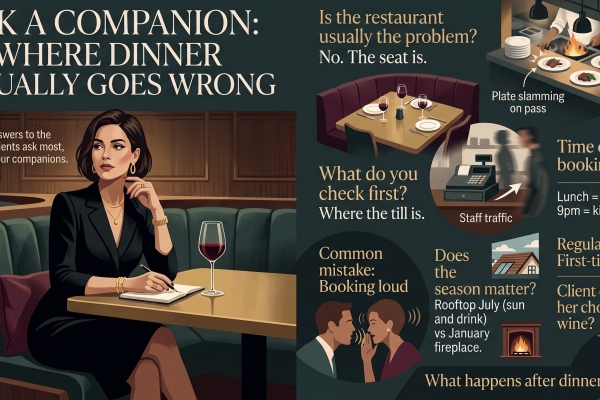 Ask a Companion: Where Dinner Actually Goes WrongAug 18, 2026A companion answers the questions clients ask most before booking a table, including what to do when they've already picked the wrong one.Read more...


