

Brazilian Companions in London: The Demand, The Reality, and The Market
From someone who has watched this industry for a long time
Companions from Brazil have ranked among the most requested nationalities at premium London escort agencies for over a decade. Through currency fluctuations and visa changes, the pattern has held. The arrival and departure of various nationalities hasn't shifted it.
Understanding why requires moving past the answers that get repeated most often. Agency marketing copy and client explanations that reach for the obvious. These aren't entirely wrong, but they're incomplete in ways that matter if you're trying to understand what's actually driving the numbers.
Beyond the stereotype
The standard explanations reach for the same three points: physical attributes, a cultural reputation for warmth and sensuality, the appeal of difference for a predominantly Northern European client base.
Physical attributes don't account for consistency over time. London has access to striking women from dozens of nationalities. If visual appeal were the primary driver, demand would distribute more evenly across those nationalities than it does.
Cultural reputation gets closer to something real but still misses it. Brazil is a country of 215 million people across enormous geographic, racial, and social variation. Treating it as a personality type is a reduction that belongs to marketing, not to serious observation.
Warmth as an explanation is the one that breaks down fastest under scrutiny. Premium clients in London have encountered enough warmth that performs itself to know the difference between that and genuine engagement. Performance doesn't hold up across three hours at a serious table.
Three qualities that actually matter
Women from Brazil who reach the top tier of London's premium market tend to share three specific characteristics. They're less about nationality and more about the particular filter that arriving at this point in the market applies to anyone, from anywhere.
São Paulo, Rio de Janeiro, Belo Horizonte: Brazil's major cities produce a specific kind of social intelligence. Class stratification that makes London's look mild. Professional contexts where interpersonal calibration matters continuously. The social fluency this builds works differently from fluency developed in more stable environments, responding to the individual rather than to a category of situation.
Brazilian culture treats touch, proximity, and physical closeness as legitimate communication channels in ways that Northern European cultures don't. Not sexuality, expressiveness. For a client paying significant money for genuine human presence, the difference between someone who communicates through words and someone who uses the full register of physical presence is felt within minutes.
What sits underneath both of these is harder still to name. Clients who try reach for words like ease, or presence, or being truly seen. Women at this tier have typically spent enough time in high-expectation environments that a certain self-consciousness has worn away. What remains is engagement that arrives without effort on either side, and without announcing itself.
None of this survives London without development. Companions who reach premium escort agency representation here have absorbed a second layer on top of whatever they arrived with: language that goes beyond functional English into socially calibrated fluency, European codes absorbed well enough to move between registers without friction. At the agencies that take placement seriously, this development is part of what gets assessed before anyone joins the roster.
London's client base at the premium end has experienced enough to recognise the difference between real quality and its imitation. Companions who can't hold intelligent conversation across an evening, or can't carry themselves in a formal setting with ease, don't last long in this market regardless of nationality. Those who do have usually been operating here for two years or more.
Booking with accuracy rather than expectation
The stereotype creates a specific mismatch that experienced agencies see regularly. Clients arrive expecting a particular cultural experience and encounter instead a professional with considerable social intelligence who has already assessed the situation before she says a word.
That can feel, briefly, like a disappointment. It's the opposite. Calibrating to the specific client rather than delivering a generalised version of what the nationality is supposed to offer is the mark of quality in this market, and agencies with genuine rosters know the difference.
Booking through an agency that can speak specifically about individual companions on its roster, rather than about the nationality as a category, is the difference between accessing that quality and paying for the stereotype.
The clients who figure this out tend to stop thinking about nationality altogether after a while. They start asking about specific women instead. That shift, when it happens, is usually a sign that something in a previous booking actually worked.
-
 Russian, British and Brazilian Escorts in London: Culture, Character and First ImpressionsOct 15, 2026Russian, British and Brazilian escorts in London: their cultural traditions, humour, ways of communicating and the misunderstandings that can arise from first impressions.Read more...
 -
 Filming With a Mask: The Look Is Half the StoryOct 07, 2026With her face covered, the eyes, outfit and mask do most of the visual work. Lace or satin, black or red, and what works best with each.Read more...
 -
 Heathrow Is Not Central London: How Much Time to Allow After LandingOct 01, 2026Landing at Heathrow with a booking in London the same day? Passport control, baggage and the trip into town all take time. This article explains how long to allow and which train suits which part of the city.Read more...
 -
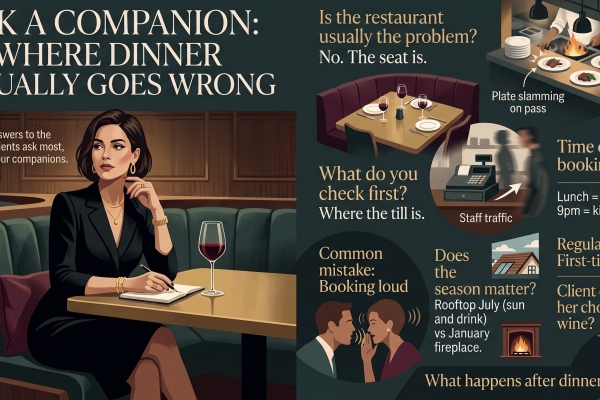 Ask a Companion: Where Dinner Actually Goes WrongAug 18, 2026A companion answers the questions clients ask most before booking a table, including what to do when they've already picked the wrong one.Read more...


